
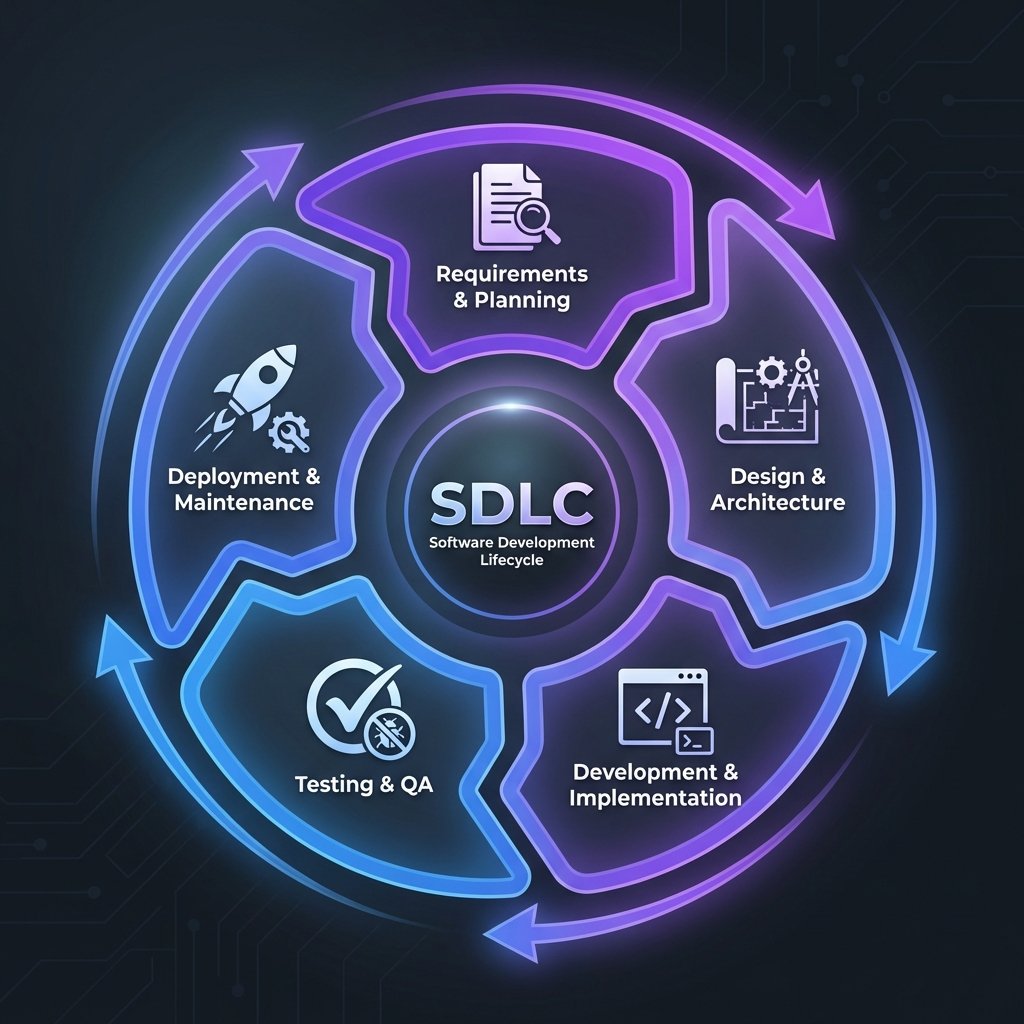
Requirements & Planning
We begin by thoroughly understanding your business needs, goals, and constraints. This phase involves stakeholder interviews, requirement gathering, and feasibility analysis to ensure we're building the right solution.
- Business requirements analysis
- Technical feasibility study
- Resource planning and estimation
- Project timeline definition
- Risk assessment and mitigation strategies
Design & Architecture
Our team creates comprehensive system architecture and detailed design specifications. We focus on scalability, maintainability, and user experience to ensure your application is built on a solid foundation.
- System architecture design
- Database schema design
- UI/UX wireframes and prototypes
- API design and documentation
- Technology stack selection
Development & Implementation
Our experienced developers bring the design to life using best practices and modern development methodologies. We emphasize clean code, modularization, and continuous integration to deliver high-quality software.
- Agile development sprints
- Code reviews and pair programming
- Version control and CI/CD pipeline setup
- Third-party integrations
- Regular progress updates and demos
Testing & QA
Quality assurance is integral to our process. We conduct comprehensive testing at multiple levels to ensure your application is reliable, secure, and performs optimally under various conditions.
- Unit testing and integration testing
- Automated testing implementation
- Performance and load testing
- Security vulnerability assessment
- User acceptance testing (UAT)
Deployment & Maintenance
We ensure smooth deployment to production and provide ongoing support to keep your application running optimally. Our maintenance services include bug fixes, performance optimization, and feature enhancements.
- Production deployment and monitoring
- Post-launch support and bug fixes
- Performance monitoring and optimization
- Regular updates and security patches
- Documentation and knowledge transfer